
Railroad back injury settlements can range from modest five-figure amounts to seven-figure recoveries, but published case results vary too much to predict what one worker will receive. A back strain that improves with treatment is very different from a herniated disc that requires surgery and ends a railroad career. Reported cases show this wide variation clearly.
Under the Federal Employers’ Liability Act, or FELA, settlement value also depends on whether railroad negligence contributed to the injury and how well the worker can prove medical and financial losses.
This guide explains how FELA back injury claims are valued without treating reported examples as a settlement formula.
Quick Facts
| Item | Key Point |
|---|---|
| Governing law | Federal Employers’ Liability Act, 45 U.S.C. §§ 51–60 |
| Basic liability rule | The worker must prove railroad negligence caused or contributed to the injury |
| Filing deadline | Generally three years from when the claim accrues |
| If the worker was partly at fault | Damages can be reduced by the worker’s percentage of fault |
| Common damages | Lost wages and benefits, future earning loss, medical expenses, and physical or emotional pain |
| Main value drivers | Diagnosis, surgery, permanent restrictions, lost railroad earnings, future care, and negligence evidence |
| Published case amounts | Useful as examples only, not as an “average settlement” |
How FELA Changes a Railroad Back Injury Claim
FELA is not a standard no-fault workers’ compensation system. The worker generally has to prove that the railroad was negligent and that this negligence caused or contributed to the injury. Federal law makes railroads liable for employee injuries resulting in whole or in part from carrier negligence.
The causation standard is important. Federal model jury instructions say railroad negligence must have played some part, no matter how slight, in causing the injury.
That can matter in cases involving unsafe footing, defective equipment, poor lifting practices, inadequate help for heavy tasks, or unsafe work methods.
FELA also uses comparative negligence. If a worker is found partly responsible, damages can generally be reduced according to the percentage of negligence assigned to that worker.
The law also restricts the assumption-of-risk defense when railroad negligence contributed to an employee’s injury.
What Are Railroad Back Injury Settlements Worth?
There is no single settlement chart for railroad back injuries. Railroad injury settlement amounts depend on the medical facts, lost income, ability to return to railroad service, future treatment, permanent limitations, and the strength of the negligence evidence.
A lower-value claim may involve conservative treatment, a short period away from work, and a full return to the same position. A higher-value railroad worker back injury claim may involve disc surgery, permanent lifting restrictions, chronic nerve symptoms, or the loss of a railroad career with years of future wages and benefits at stake.
The better question is what losses can be proved and how strong the negligence evidence is.
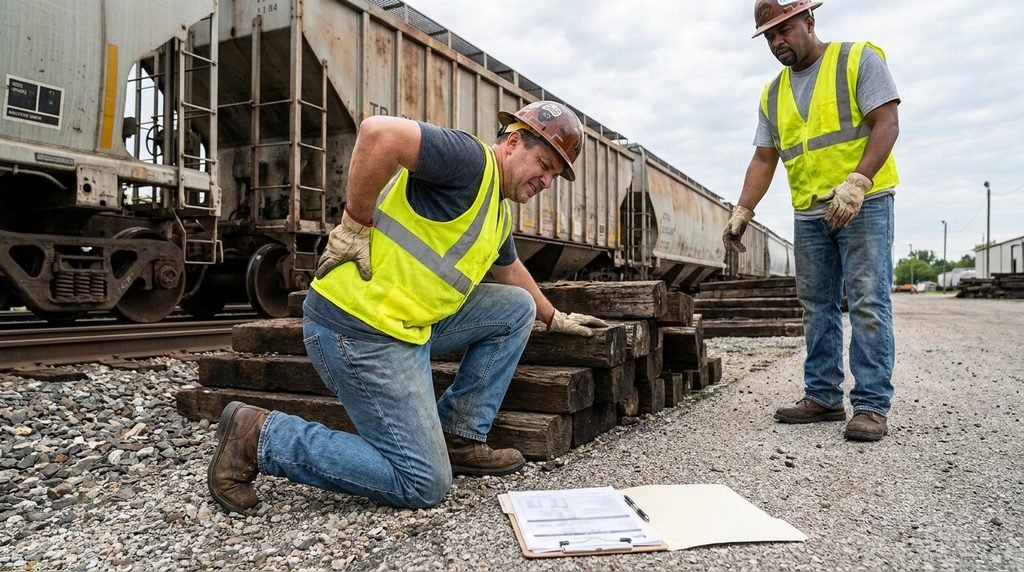
Reported Railroad Back Injury Examples
Published results show why averages can be misleading.
- $60,000 settlement: Michigan Lawyers Weekly reported a 2002 FELA case involving a railroad carman with a back injury and work restrictions who remained employed.
- $125,000 settlement: The publication also reported a railroad carman with a ruptured disc after slipping on ice. He later returned to railroad employment in a higher-paying dispatcher position.
- $200,000 settlement: Peter Higgins Law reports a cumulative-trauma case involving a locomotive mechanic who underwent disc surgery and later received a spinal cord stimulator.
- $295,000 settlement: Michigan Lawyers Weekly reported a 1997 case involving aggravation of a pre-existing back condition, lumbar disc surgery, and medical disqualification from returning to the railroad job.
- $400,000 settlement: Shapiro, Washburn & Sharp reports a 2022 case involving a railroad yard foreman who injured his back while using allegedly defective equipment and could not return to regular duty.
Seven-figure results also appear in law-firm listings, but they should not be treated as typical. Some published numbers are verdicts rather than settlements, and result pages highlight selected cases.
What Factors Affect Settlement Value?
The medical diagnosis is one of the biggest factors. A temporary lumbar strain is usually very different from a herniated disc, nerve compression, spinal surgery, or a condition that leaves permanent restrictions.
Consistent medical records can also help establish how serious and long-lasting the injury is. A clear connection between the accident, diagnosis, treatment, and continuing symptoms can make the damages easier to evaluate.
Ability to return to railroad work can be just as important. Railroad jobs often involve climbing, lifting, pulling, pushing, walking on uneven surfaces, and handling heavy equipment. If permanent restrictions prevent a worker from returning to a higher-paying railroad position, future earning loss may become a major part of the FELA settlement value.
Negligence evidence matters too. Photos, witness statements, maintenance records, safety reports, and proof of a known hazard can affect how both sides evaluate the risk of going to trial.
What Damages Can a FELA Back Injury Claim Include?
Federal FELA jury materials identify categories that can include past and future lost wages and benefits, past and future medical expenses, mental or emotional pain, and physical pain and suffering. The damages available in a particular case depend on the evidence.
Future earning capacity can be especially important when a worker is still able to work but can no longer earn the same railroad income.
For example, a worker may be medically unable to perform heavy railroad duties but capable of taking a lighter job that pays much less. The difference between those earnings can become important when evaluating long-term losses.
Future medical care may also matter when doctors expect surgery, therapy, injections, medication, or other continuing treatment.
Cumulative Trauma Back Injuries
Not every railroad back injury happens during one fall or one lifting accident. Some conditions develop after years of repeated lifting, vibration, awkward positions, climbing, or other heavy physical work.
The Supreme Court’s decision in Urie v. Thompson recognized that slowly developing occupational injuries require a different limitations analysis from a clearly identifiable single accident.
Later FELA cases commonly examine when the worker knew, or reasonably should have known, that an injury existed and that it was connected to railroad work.
This means the three-year period does not always turn on the first day of back pain. However, waiting can still be risky because the railroad may argue that the worker knew about the work-related condition much earlier.
Why Early Settlement Offers Need Careful Review
Back injuries can be difficult to evaluate during the first weeks after an accident. An injury first described as a strain may later be shown on an MRI to involve a herniated disc or nerve damage.
One FELA law firm describes a worker who settled after what initially appeared to be a limited low-back injury. The worker later learned that the original accident had caused a disc herniation requiring surgery. According to the firm’s account, the signed release prevented a later recovery for those additional consequences.
Recent competitor coverage also warns that an early offer may arrive before doctors know whether surgery, permanent restrictions, or loss of railroad employment will result.
The point is not that every early offer is unfair. The medical outlook and work restrictions should be understood before a final release ends the claim.
How Long Do You Have to File?
FELA generally requires an action to be started within three years after the cause of action accrues.
For a clear accident, the injury date is usually an important reference point. For cumulative or latent injuries, determining when the claim accrued can be more complicated.
Because missing the deadline can end a claim, workers with older or gradually developing back problems should get case-specific advice instead of relying only on a general online date calculation.
2026 Update: Injury Reporting and Retaliation
In March 2026, the U.S. Department of Labor announced that OSHA found Union Pacific violated the Federal Railroad Safety Act after terminating a switchman/conductor who had reported and sought medical treatment for a work-related injury.
OSHA ordered reinstatement and more than $315,000 in back wages, interest, compensatory and punitive damages, and attorney’s fees.
That was a whistleblower matter, not a FELA back injury settlement, so the amount should not be used to estimate an injury claim. It shows that injury-reporting retaliation remains active in 2026.
Settlement vs. Trial Verdict
A settlement is an agreement between the worker and railroad. A verdict is an amount awarded after a case goes to trial.
This difference matters because search results often place settlements and jury verdicts together. For example, reported FELA back injury verdicts have reached seven figures, but a jury award from a particular case does not establish what another worker will receive in settlement.
Settlements provide a negotiated resolution, while trials carry more uncertainty. In either situation, medical proof, future work limitations, negligence evidence, economic loss, and expected trial risk can influence the final number.
For readers comparing another common railroad injury, Settlemate’s railroad shoulder injury settlements guide covers many similar FELA value factors.
Frequently Asked Questions
Is there an average railroad back injury settlement?
No dependable public average can predict an individual case. Published results involve very different diagnoses, wage losses, negligence facts, treatment histories, and work restrictions.
A reported $400,000 case involving permanent employment restrictions should not be used to value a worker who makes a full recovery after several weeks, just as a smaller settlement does not establish the value of a career-ending spinal injury.
Can I recover if I was partly at fault?
Potentially, yes. Under FELA, the worker’s negligence generally reduces damages according to the worker’s share of fault rather than automatically preventing recovery.
Does a herniated disc automatically lead to a large settlement?
No. A herniated disc can be serious, but settlement value still depends on treatment, surgery, permanent restrictions, lost earnings, future care, and evidence showing that railroad negligence contributed to the injury.
Can repetitive railroad work cause a valid FELA back claim?
Yes. Cumulative trauma can support a FELA claim when the legal and medical evidence connects the condition to railroad work and negligence. The filing-deadline analysis can be more complicated than in a one-time accident.
What if I already had back problems?
A pre-existing condition does not automatically eliminate a claim. One reported FELA settlement involved aggravation of a pre-existing back condition that eventually required lumbar surgery.
The important question is whether railroad negligence caused a new injury or worsened an existing condition, and what additional harm can be proved.
How This Was Researched
I researched this article using the FELA statute, federal model jury instructions, Supreme Court authority, recent Department of Labor reporting, legal news archives, and published railroad injury case results. I also reviewed ranking articles focused on railroad back injury settlements, settlement value, and early settlement risks, including Doran & Murphy, LegalClarity, FELA Attorney, Cahill & Perry, Shapiro Washburn & Sharp, and Peter Higgins Law.
A common weakness was mixing verdicts with settlements or presenting isolated case amounts without enough context. This article separates those categories, grounds the legal rules in primary or federal sources where possible, and avoids presenting selected case results as an average.
Accuracy Note
This article is based on publicly available federal law, court materials, government reporting, legal news archives, and published case-result pages reviewed in September 2026. FELA claims are fact-specific, and this article is general information rather than legal advice.
If you spot anything outdated or incorrect, please let us know so it can be reviewed and updated.
Written and researched by Kevin Tookes, contributor at settlemateapp.com.