Wendy Williams A&E Lawsuit Settlement: What Was Resolved, What Stays Secret, and What Happens Next

The Wendy Williams A&E lawsuit settlement became public on July 21, 2026, when TMZ reported that Williams’ court-appointed guardian, Sabrina Morrissey, and A&E Television Networks had told a New York court they had resolved all issues and that the case over the Lifetime documentary Where Is Wendy Williams? was being dropped. Rolling Stone later described the joint court filing in more detail. The figures most readers want are still missing, and the settlement answers far less than many headlines suggest.
This article separates what the court record and credible reporting actually show from what readers tend to assume, and it checks the situation against the latest news as of November 25, 2026.
What is on the record, and what nobody has made public
| Question | Where it stands |
|---|---|
| Is the case over? | Yes. Both sides told the court all issues were resolved and the lawsuit was dismissed. |
| What did the joint filing cover? | According to Rolling Stone, the settlement agreement, proposed attorneys’ fees and costs for Williams’ lawyers, and the proposed distribution of any payment. |
| How much was paid? | Not disclosed by any reliable source. |
| How is the money split between Williams and her lawyers? | Not disclosed. |
| Did A&E admit wrongdoing? | No admission has been reported, and no judge ruled on the merits. |
| Did the settlement change the guardianship? | No. It is a separate matter. |
Nearly every page covering this news traces back to two original reports, TMZ and Rolling Stone, which is why the same handful of facts repeats across dozens of sites and why details are so thin. Neither outlet published the agreement itself, and representatives for Williams and A&E did not immediately comment when Rolling Stone asked. Treat any site that quotes a payout number with suspicion, because none of the reliable reports reviewed for this article included one.
How a documentary dispute turned into a two-year lawsuit
The fight started days before the series aired. On Thursday, February 22, 2024, Morrissey sued A&E and the production company Entertainment One Reality Productions in New York County Supreme Court, under seal, asking for a temporary restraining order and an injunction. The same day, Williams’ care team publicly disclosed that she had been diagnosed with primary progressive aphasia and frontotemporal dementia. A restraining order that had been signed without the networks present was vacated the next day by Appellate Justice Peter Moulton, who wrote that blocking the broadcast would be an “impermissible prior restraint on speech” under the First Amendment, as reported by the Associated Press and CNN. The two-part series then aired on Lifetime on February 24 and 25.
The production itself had begun in 2022 as a comeback project. According to the Associated Press’s account of the film, the crew stopped filming in April 2023, when Williams entered a facility to treat cognitive issues. After the original complaint was unsealed in mid-March 2024, it became clear that Morrissey’s core argument was that Williams lacked the capacity to consent to the contract she was said to have signed.
On September 16, 2024, Morrissey filed an amended complaint with Roberta Kaplan’s law firm. It added Lifetime Entertainment Services, Creature Films and producer Mark Ford as defendants and asked for a declaration that the contract was void, unspecified compensatory and punitive damages, the handing over of the documentary’s proceeds, and a bar on further airings. A&E rejected the claim that Williams should not have been filmed, according to theGrio’s summary of the case.

The $82,000 figure and the “millions” claim are allegations, not findings
The number that circulated most widely was $82,000, which the amended complaint said Williams personally received for taking part in the series. The same filing said the defendants had made millions and asked that profits go to Williams, who it said would need significant funding for medical care and supervision for the rest of her life. It also said that the signature on her talent agreement “does not appear to be genuine,” that the agreement was drafted only after filming had started, and that the guardian was not shown it until months after it was supposedly signed.
All of this comes from one side’s complaint. None of it was tested at trial, and because the case ended by agreement, no court decided whether it was true. As a general rule in civil cases, a settlement is not an admission that the other side’s account was correct. That cuts both ways: the outcome does not prove A&E exploited Williams, and it does not prove the production behaved properly. Anyone who tells you the settlement “proves” either version is going further than the record allows.
Williams herself did not fully back the case
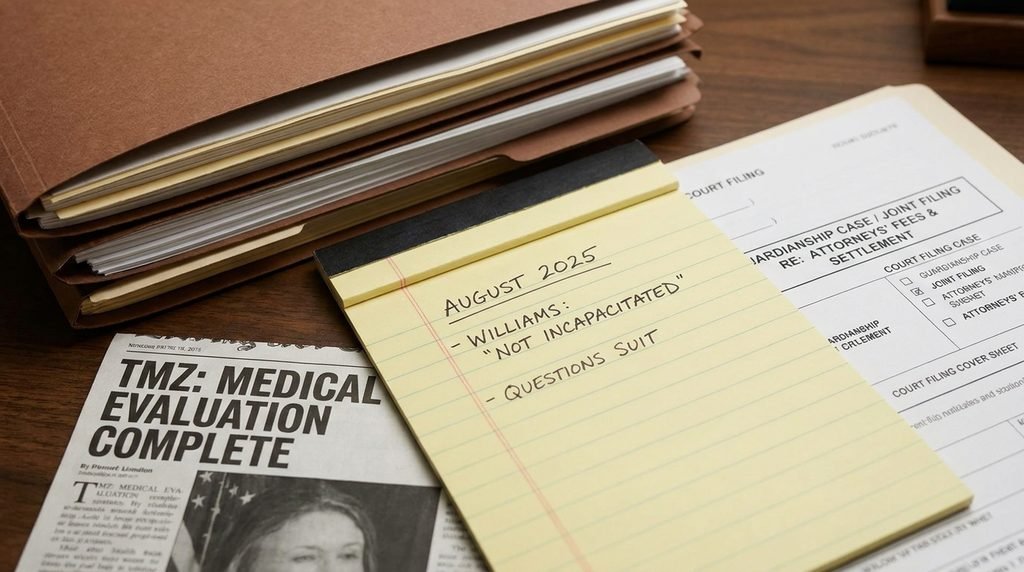
A detail that top pages mostly skip is that the person at the center of the lawsuit questioned it. In early 2025, Williams said publicly that she was not incapacitated and wondered about continuing the suit, and her guardian responded by asking for a new medical evaluation, according to theGrio. A later court filing acknowledged that she had suggested she wanted the litigation to end but said her capacity to make that decision needed further review. In August 2025, TMZ reported that Morrissey said the evaluation was complete and that specialists had formed an opinion on whether Williams could make decisions about the A&E case. The sources reviewed for this article do not say what that opinion was.
So the settlement was reached by a guardian acting on behalf of someone who had signaled mixed feelings about the fight. That helps explain why the joint filing dealt with attorneys’ fees and the distribution of payment rather than only a simple dismissal.
Did the settlement change anything about the guardianship?
No, and this is the most common mix-up. The guardianship dates to 2022 and runs through a different proceeding. Coverage in July 2026 noted that Williams remained in an assisted living facility while pursuing efforts to end it.
The latest news is from this month. On a WABC radio show, her personal attorney Joe Tacopina said the guardian refused permission for a Thanksgiving trip to see family in Miami, that the guardian holds her identification documents, and that a court conference set for November 6 was canceled with no new date. He also said Williams had been led to believe the arrangement would end around Christmas 2025. Those are his statements, and the coverage reviewed here did not include a response from Morrissey on the Thanksgiving claim. In 2025, a lawyer for Morrissey told ABC News that she had done nothing wrong and that the court supervises her work. The state guardianship file is sealed, according to a public order in a separate federal case, which limits what outsiders can confirm.
The medical picture is also contested. Inside Radio reported that a judge denied Williams’ motion to end the guardianship in August 2025 after an evaluation that reaffirmed the dementia and aphasia diagnoses. It later reported, citing TMZ, that a neurologist who tested her found she does not have frontotemporal dementia. Tacopina has disputed the earlier findings and accused the guardian’s side of leaking them, which the guardian’s side has not been reported to have accepted.
Questions that come up after the settlement
Why did a judge let the documentary air if the guardian said Williams could not consent? The ruling was not about whether the consent claim was true. U.S. courts are extremely reluctant to block publication in advance, so the judge treated the request as a prior restraint on speech. The consent and contract claims were left to be argued afterward as claims for money and other relief, which is exactly the lawsuit that has now settled.
Is Joe Tacopina part of the settled case? Nothing in the coverage reviewed says so. He joined Williams’ team in 2025 and has said he is her personal lawyer, not her attorney in the guardianship proceeding. The attorneys named in the reporting on the settlement were Williams’ lawyers in the A&E case, but the reports do not identify them.
Where could new information come from? Mostly from court dockets. A rescheduled guardianship conference, or any public filing about how settlement money is allocated, would be the first real news. Tacopina has said his team is preparing further legal steps to get Williams a formal hearing, though no date is public.
A note on sources
This article summarizes public court filings and press reports as of November 25, 2026. It is not legal advice, and it takes no position on Williams’ health or on whether the guardianship is justified, since much of that record is sealed or disputed.
Where this leaves things
The Wendy Williams A&E lawsuit settlement closes one case without telling the public its price, without a ruling on who was right, and without touching the larger fight over Williams’ autonomy. The next verifiable developments will most likely be a new court date in the guardianship and, if it surfaces, a docket entry about how any payment is divided. Until then, claims about the amount or the outcome that are not tied to a court document or a named news report should be treated as rumor.
EXPLORE MORE: www.blueflamepublishing .net: A Blog, Not a Book Publisher, and Why Search Results Say Otherwise
Related Posts

Schwab Corrente Settlement: No Payment for Customers, but a Compliance Program and an Open Appeal
If you have a Schwab brokerage account, you may have received an email about the schwab corrente settlement…

Phoenix Settlement Administrators: Who They Are and How to Check a Notice or Check
If a letter, email, or check with the name phoenix settlement administrators on it just landed in your…

Discover Card Merchant Class Action Settlement: Status, Payment Timing and What Merchants Should Do Now
The Discover card merchant class action settlement has cleared its last major court hurdle and the claim window…
1 Comment