Dexcom G7 Lawsuit Problems: What Is Confirmed, What Is Only Alleged, and Where the Cases Stand

The Dexcom G7 lawsuit problems you see in headlines mix together three very different things: official FDA actions, claims that plaintiffs have made in court, and reporting by outside investigators. Only the first group has been confirmed by a regulator, while the rest are allegations that no court has ruled on yet. This guide separates them, explains what each type of case is really about, and ends with practical steps for people who rely on the sensor every day.
The short version is that there is more than one lawsuit, the recalls behind them are real and documented, and the central question of whether the G7 is less accurate than it should be is still being argued. I found no settlement announced in Dexcom’s own financial filings or in reputable news coverage, and no court has certified a class of G7 users.
How many Dexcom G7 lawsuits are there, and what stage are they in?
People often say “the lawsuit” as if there were one, but the cases fall into four separate groups that move at different speeds and ask for different things.
| Type of case | Who is suing | Main argument | Where it stands |
|---|---|---|---|
| Federal consumer class actions | Buyers of G6 and G7 products | They paid more than the devices were worth | Five cases were merged on May 15, 2026 as In re: Dexcom CGM Litigation in the Southern District of California; rival law firms are still asking to lead the case |
| State class action | A buyer in Los Angeles County | Same overpayment theory | Paused in favor of the federal cases through at least February 26, 2027 |
| Individual injury lawsuits | Patients and families | A malfunction caused a medical emergency | Filed separately; one firm says it has 11 cases, many in San Diego County Superior Court |
| Investor lawsuit | Shareholders | Dexcom allegedly overstated how reliable the G7 was | Filed in federal court in New York; I could not confirm its current status |
All six consumer class complaints were filed between September 29, 2025 and January 8, 2026, according to Dexcom’s own annual report. That window opened soon after the recalls described below and just after a widely shared investigative report appeared in September 2025. Dexcom has said in its quarterly filings that it intends to defend itself vigorously.
What has the FDA actually confirmed about G7 problems?
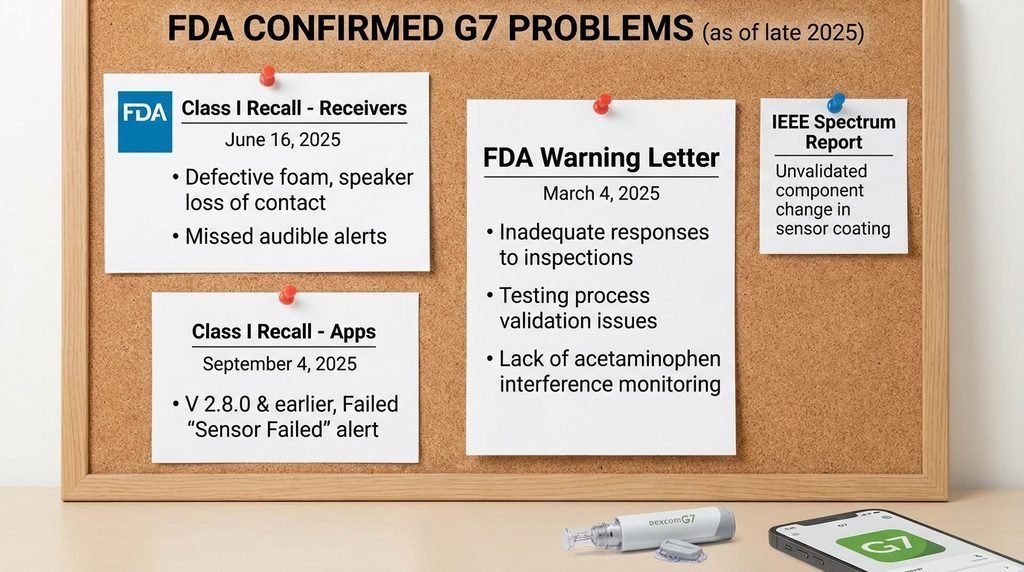
The firmest ground comes from FDA records, because those are official and dated. Two G7-related actions were classified as Class I, which is the FDA’s most serious recall category. That label describes the potential risk if a problem goes unaddressed. It does not tell you how many people were actually harmed.
The first involved receivers, the handheld devices some people use instead of a phone. Dexcom began the correction on May 12, 2025, and the FDA classified it as Class I on June 16, 2025. The FDA’s records say defective foam or an assembly error could make the speaker lose contact with the circuit board, which can lead to missed audible alerts for dangerously low or high glucose. Dexcom said affected receivers still alert through vibration and on-screen prompts and that accuracy is not affected. MedTech Dive reported that Dexcom had received 56 reports of severe adverse events, such as seizures and loss of consciousness, tied to this problem. The recall also covered G6 and some international models, and published unit counts differ from source to source.
The second involved the phone and watch apps. Dexcom started that correction on July 24, 2025, and the FDA posted the recall on September 4, 2025. The affected app versions, 2.8.0 and earlier, failed to show a “Sensor Failed” alert when the transmitter had a hardware or firmware error. Instead, the app ended the session and told the person to start a new sensor, which could leave someone unaware that glucose readings had stopped. Dexcom made the update mandatory, and the older versions stopped working after August 20, 2025.
Alongside those recalls, the FDA sent Dexcom a warning letter dated March 4, 2025, after inspections of its San Diego site in late 2024 and its Mesa, Arizona site in mid-2024. The letter said Dexcom’s replies to the inspectors’ findings were not adequate. It pointed to how sensors are accepted or rejected during testing, to a process that was not properly validated, and to the lack of monitoring for acetaminophen interference in G7 devices. Dexcom told investors the letter did not restrict production or sales and did not require a recall.
IEEE Spectrum later reported that for some batches the problem may have been tied to an unvalidated change in a component of the sensor’s coating, which performed worse than the original. According to that report, Dexcom’s representative said the material has since been removed from all G7 sensors.
What do the lawsuits and outside reports claim that nobody has proven yet?
Several of the most dramatic claims come from complaints and investigative articles, so they carry a different weight than the FDA records above.
The lead consumer complaint, filed by a parent named Kelly Grisoli, says the sensors she bought for her child often failed well before the advertised ten days, sometimes after about two days. It also says readings were far off from fingerstick checks. These are the plaintiff’s own descriptions, and the court has not tested them.
The September 2025 report from Hunterbrook Media described users who were hospitalized or died after wrong G7 readings and said the company made an unapproved coating change in December 2023. Two details matter when you weigh it. Hunterbrook’s affiliated investment firm disclosed that it held a short position in Dexcom stock, meaning it could profit if the share price fell, and Reuters noted it could not independently verify the claims. A follow-up report counted deaths mentioned in reports sent to the FDA’s public adverse event database. Those entries are unverified submissions, and they do not prove the device caused the event; in one case highlighted by the outlet itself, the report said the probable cause could not be determined.
Dexcom’s side deserves equal space. On its October 2025 earnings call, company leaders said they were pleased with the quality of the sensors being made and linked many complaints to inserter problems, Bluetooth connection issues, and adhesive. IEEE Spectrum also noted that, by a standard accuracy measure used in the industry, the G7 is among the most accurate sensors available, and a Dexcom executive said a clinical trial showed it to be significantly more accurate than the G6. Both things can be true at once: a design can test well in trials and still perform worse in certain manufacturing batches.
Class action or injury lawsuit: what each one can and cannot do
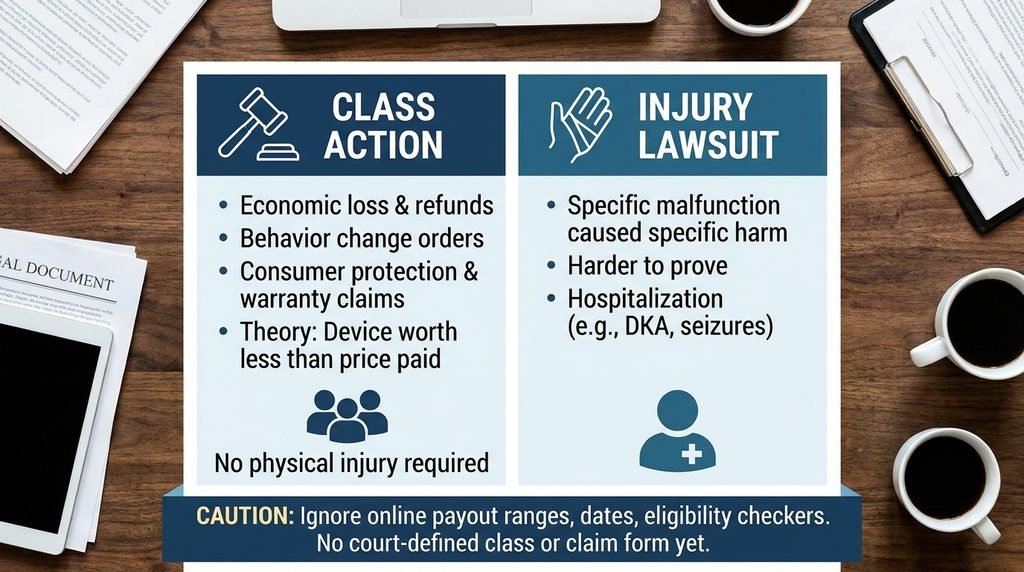
The difference between these two tracks explains most of the confusion online. A consumer class action does not require anyone to have been hurt. Dexcom’s filings say the plaintiffs seek money for economic loss, refunds of what they paid, and court orders changing the company’s behavior, based on claims such as consumer protection and warranty laws. The theory is that a device which allegedly did not work as promised was worth less than the price paid.
An injury lawsuit works the other way around. The person must show that a specific malfunction caused a specific harm, and that is much harder to prove. The recent filings by Morgan & Morgan, for example, involve two girls aged 7 and 10 who were hospitalized, one with diabetic ketoacidosis and one with seizures after a severe low. Those facts come from the family’s complaints and have not been decided by a judge.
Be careful with websites that list payout ranges, purchase date windows, or “eligibility checkers.” Those pages are usually run by law firms looking for clients, and none of the dollar figures or date ranges I saw came from a court order or settlement. No judge has defined who belongs to a class, so there is no claim form to file today.
What G7 users can do right now
Nothing in the lawsuits changes the basics of using a glucose monitor safely, and none of this replaces advice from your own care team.
- Update the app to the current version and, if you use a receiver, enter its serial number on Dexcom’s receiver check page to see whether it was part of the recall. Dexcom also advises testing the receiver speaker every time you charge it.
- When a reading does not match how you feel, confirm it with a fingerstick meter and ask your doctor when you should do that as a routine.
- Report sensor failures and bad readings to Dexcom technical support (the US number listed in the FDA notice is 1-844-478-1600) and to the FDA’s MedWatch program, which feeds the same database that investigators and lawyers study.
- Keep screenshots, lot numbers, purchase records, and any hospital paperwork, because they matter if you ever decide to speak with a lawyer.
- Do not stop wearing a sensor without a backup plan from your care team, since having no monitoring is its own danger.
What to watch in the coming months
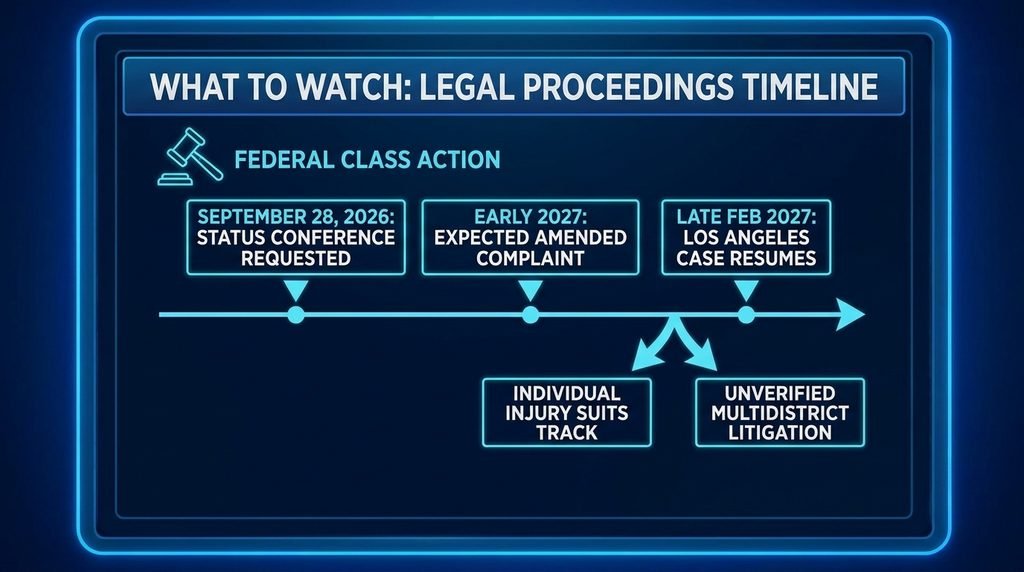
The next steps in the federal class action are procedural. The court first has to choose which law firm leads the combined case, and Dexcom’s filing says the plaintiffs then expect to file an amended complaint that merges the earlier ones. After that, Dexcom is expected to ask the court to dismiss it. On September 28, 2026, a plaintiff asked the judge for a status conference to set that schedule, and the company reported that no date-certain deadlines exist yet. The Los Angeles case stays paused until at least late February 2027, while the individual injury suits move on their own track.
Some law firm websites claim that a multidistrict litigation, a special federal process for grouping many injury cases, has been requested or granted for the G7. I could not confirm that from any official source, so treat it as unverified for now.
The bottom line on Dexcom G7 lawsuit problems
The safety fixes for receivers and apps are documented by the FDA, and the warning letter shows regulators found weaknesses in how the sensors were made and tested. The claims about widespread inaccuracy, deaths, and company knowledge remain allegations that courts have not decided, and the people making some of them have clear financial or legal interests. The practical takeaway is to keep your software and receivers current, trust your own symptoms over a surprising number, and report problems, while the Dexcom G7 lawsuit problems continue through the courts.
Disclaimer: This article is for general information only and is not medical or legal advice. Talk to your doctor about your glucose monitoring and to a licensed attorney about any legal claim. Court cases and FDA records change, so check current status before making decisions.
EXPLORE MORE: Timothy Stanhope National Guard Settlement: What the North Carolina Guard Agreed To
Related Posts

Adriana Walsh Student Loan Lawsuit: What the Case Claims, Where It Stands, and What Borrowers Can Do
The Adriana Walsh student loan lawsuit is a proposed class action against the U.S. Department of Education, filed…

DR Horton Lawsuit: What the Nevada Escrow Case Claims, Where It Stands Today, and Which Other Cases Get Mixed In
When someone searches for the DR Horton lawsuit, they almost always mean one case: a proposed class action…

Lawsuits Imre Kifor Is Involved In: What Public Court Records Show
Anyone searching for lawsuits imre kifor will find almost no news coverage and a large pile of raw…
1 Comment